Feelings Made Visible


Finding representation in Nature


Perhaps as a very sensitive introvert with a deep desire to not be seen growing up our human mask or shield is something that’s always fascinated me. This impenetrable facade is something that’s either always present in my work or the effort to see behind the mask is what my paintings strive to explore but in different ways. I’ve always been fascinated by what feelings and thoughts humans choose to hide or share. I started thinking of our faces as a facade that conceals any number of goings on behind it. How interesting would it be if that was beyond our control (scary perhaps!).

These works came from the thought What if our emotions or thoughts were visible to everyone? What would represent those expressions in nature? It could be floral or animal.

A stern woman that hides her passion represented by wild roses that bloom behind her. This was my first piece exploring this idea. The shadows / silhouettes leaves and flowers along with the delicate pencil drawn roses speaks to her insecurity at expressing this side of herself. Her heart is bright red because it is full and guides her through the fear on following her bliss.


Wild Roses, 2013

Acrylic, graphite on wood panel

24″ x 18″

Available

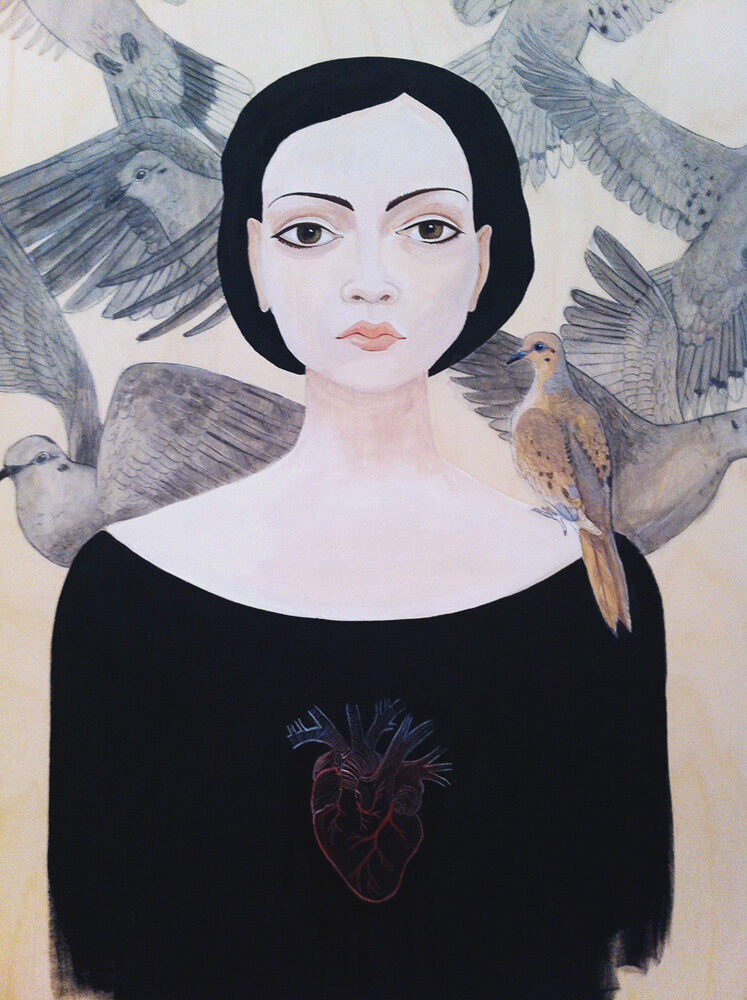
Mourning doves showing the sadness this still woman conceals. Her heart is fragile. The still bird speak to the weight and the flying doves represent the chaos of all the feelings that come with loss and the unknown.


Mourning Doves, 2013

Acrylic, graphite on wood panel

24″ x 18″

SOLD

A few years later I revisited this idea. This time I explored how sometimes we are not aware how our words can be seen by others.

In this piece fear and worry are represented by moths.


All She Talked About Was Her Fears, 2014

Watercolor on watercolor paper

17″ x 13″

Available

In this piece bugs, beetles represent the mean talk coming from this woman’s words.


Her Words Are Always Mean, 2014

Watercolor on watercolor paper

17″ x 13″

Available

The Emotional Power of Everyday Objects in Contemporary Art

Contemporary female artists like Andrea Bowers and Arghavan Khosravi use objects in art to tell difficult truths without illustrating them directly. Rather than depicting events literally, they infuse objects with layered meaning to convey stories more subtly. In doing so, replacing the human figure with symbolic forms offers viewers a filter through which to enter challenging subject matter.

Similarly, in my contemporary paintings, I replace the human figure with symbolic objects to explore themes of childhood memory and motherhood. For example, the first work examines false role models in parenting through the use of a doll’s head. By contrast, the second piece uses a doll’s head to evoke overwhelming feelings from childhood.

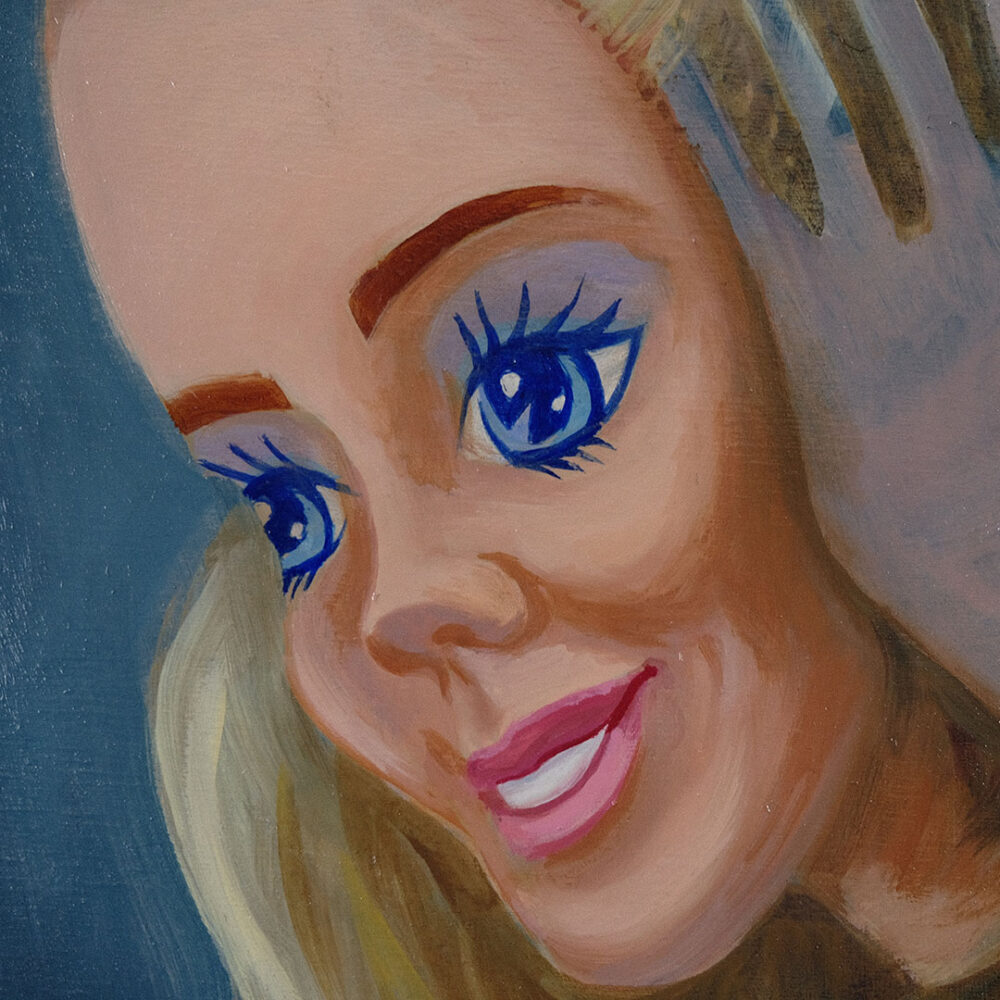
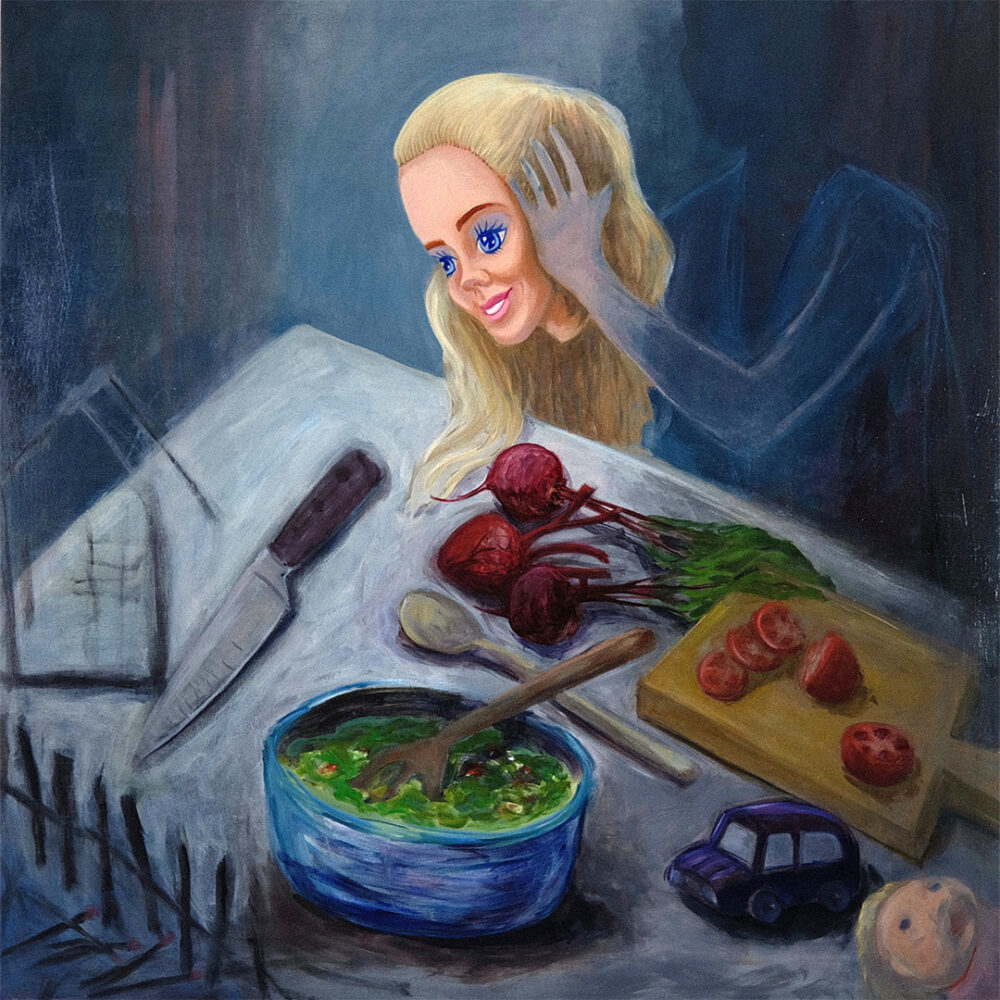
More specifically, in my 2017 work False Role Model, I explore the tension I experienced in motherhood. Here, Barbie becomes a representation of the “super mom.” At the same time, as we learn more about child-rearing, the question “What kind of parenting do you practice?” has become common and often judgmental.

Furthermore, with the rise of social media, the pressure on mothers has intensified. Pinterest boards and carefully curated feeds reinforce unrealistic expectations. Everywhere, we see busy moms running six-figure businesses, dressed impeccably, preparing healthy meals, and maintaining immaculate homes. Within this cultural landscape, Barbie represents the false ideal many women feel compelled to emulate.

Ultimately, she becomes an impossible role model — one that breeds unhappiness, frustration, and can lead to depression.

Barbie is Not a Mother” 2017 Oil on wood panel 36″ by 36″ (91.5 cm by 91.5 cm)


It’s an impossible standard to live up to.


In this painting, the table depicts the early stages of meal preparation alongside children’s toys. The never-ending daily tasks — cooking, cleaning, and caregiving — create a constant sense of chaos, both visually and mentally. Through these objects, I represent the basic needs we fulfill as mothers, such as feeding our children, while also suggesting the joys we hope to nurture — a child at play is implied through the scattered toys.

At the same time, among the beets, a human heart appears, symbolizing how much of ourselves we give as mothers. Similarly, the fence represents the tension between the deep instinct to keep our children safe and the caged feeling that can accompany so much responsibility.

Furthermore, the Barbie head — the so-called “perfect mother” — functions as a kind of mask. As it is removed, the figure beneath it appears undefined, almost absent. In this way, the painting marked a monumental shift in my perception of motherhood. When I finally set aside the pressures I felt — the tug-of-war between responsibilities, aspirations, and persistent self-doubt — I realized that my struggle was not simply about time management.The deeper issue was that I no longer knew who I was without the label of “mother.”

I had become missing from my own life.

contemporary artist childhood memory

As a highly sensitive child who immigrated to Canada at the age of three, school was always a struggle. When I think back to my childhood, I realize I don’t remember much. I believe this is because I spent so much time trying not to feel.

As a contemporary female artist, expressing these uncomfortable moments is central to my body of work. In this painting, I chose my childhood doll to represent that desire to hide. I used the head to symbolize the façade a child creates and rendered it clearly. The body, representing feelings that are too difficult to face, is abstract and only suggested. It suggests a disconnect between the head and the body.

In the background, a playground is faintly hinted at, forming a murky and indistinct landscape.

Playground Memories“, 2017 Oil on stretched canvas

16″ by 16″

Where am I in “motherhood”?

Many artists’ journeys follow this classic tale: They “know” from an early age that they want to be an artist. They draw as kids, they are encouraged by a high school art teacher or someone they respect. It’s what they’ve always enjoyed. And then years later (like 30 for me!!!) they finally step into their creative passion and have the confidence to call themselves artists.


What is really fascinating about these journeys is how life has a way to gently guide us to our fulfilled lives through our greatest challenges.


False Role Model” 2017 Oil on wood panel 36″ by 36″ (91.5 cm by 91.5 cm)


In 2011 I became a mother for the first time. The year my son was born I did the most craft fairs I had even done. These shows were a way for me to see if my work was appreciated and to become part of the art world. It was a big, fulfilling year! It was a personal success and financial failure (which caused years of questioning).

And then…motherhood.

An intense inner pull to selflessness that the bond with a child brings. I did what I had to do. Living in a state of suspended ‘now’ (perhaps similar to Covid times…). As I tried to figure out my career I felt all the frustration of not having ‘my time’. With my husband’s support I decided to go back to school and do a BFA. I was a mature student in my 40s surrounded by 20 year olds. I had nothing to fear but being dishonest with myself. It was the perfect setting for me. It’s the safe container I needed to come out of myself.

It all started with a painting (the one above). At first my journey into motherhood felt like I was mourning the loss of my alone time. My time had become the family’s, my son’s. But through this painting and subsequent others I quickly came to realize that I hadn’t lost “my” time but that I had in fact no idea of who I was.

I had found myself missing from my own life.

I had lived from the role of ‘daughter’ to ‘student’ to ‘girlfriend’ to ‘partner’ to ‘mother’ and then to ‘home maker’. Trying to live up to my upbringing and perhaps society’s image (Hello Pinterest 🙂). I had preconceived ideas of who I was suppose to be (that I wasn’t even aware of!?!). I struggled to ignore my individuality and resign myself to trying to perform those roles well. Through art I was allowing my own truth to speak. The lost part of me that felt it didn’t have a place in this new world of motherhood started to emerge.

Through a series of paintings I came to understand that motherhood was a relationship I had to work on not only in connection to others but to myself. You can see the full (to date) Finding Yourself Missing collection HERE.

A list of my authentic beliefs: My Creed

I recently came across a simple but powerful exercise:
Write a list of your authentic beliefs as guide.

Create your own set of beliefs to guide you.

We live in a world constantly bombarding us with shoulds and coulds — who we should be, what we should want, how we should live. Taking the time to name what you actually believe is surprisingly freeing.

For me, writing this list brought my core values front and centre. Each time I read it, I feel rooted in my truth. It reminds me that I am strong. It reminds me to live authentically.

Of course, understanding what we believe is ongoing work. It shifts as we grow. At first, it can feel vulnerable — even scary — to name those beliefs out loud.

Many of mine revolve around authenticity, relationships, and learning to accept the darker parts of myself. Recognizing that those parts are not flaws, but essential pieces of who I am — and perhaps even part of my purpose.

Here’s the exercise: – The Goal is 5 to 10 ideas

  1. Write down everything you believe — without editing yourself.

  2. When you’re done, read it over slowly.

  3. Notice which statements feel deeply true.

  4. Keep the ones that give you strength and grounding.

The beliefs that matter will feel steady. They’ll give you something to stand on — and something to soar from.

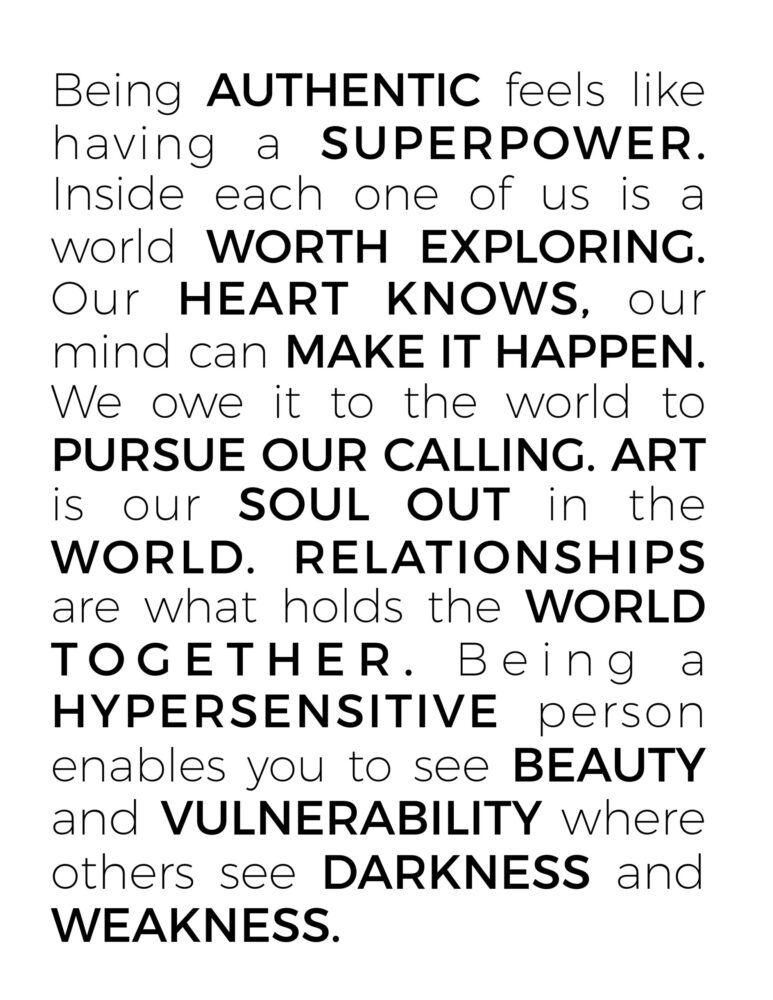
Here is what I know to be true (for now).

What do you believe?

I highly recommend you write a list of your authentic beliefs as guide— and sitting quietly with whatever comes up. And if you’re like me, turning it into a visually beautiful, graphically satisfying poster makes it even more powerful.