The Emotional Power of Everyday Objects in Contemporary Art

Contemporary female artists like Andrea Bowers and Arghavan Khosravi use objects in art to tell difficult truths without illustrating them directly. Rather than depicting events literally, they infuse objects with layered meaning to convey stories more subtly. In doing so, replacing the human figure with symbolic forms offers viewers a filter through which to enter challenging subject matter.

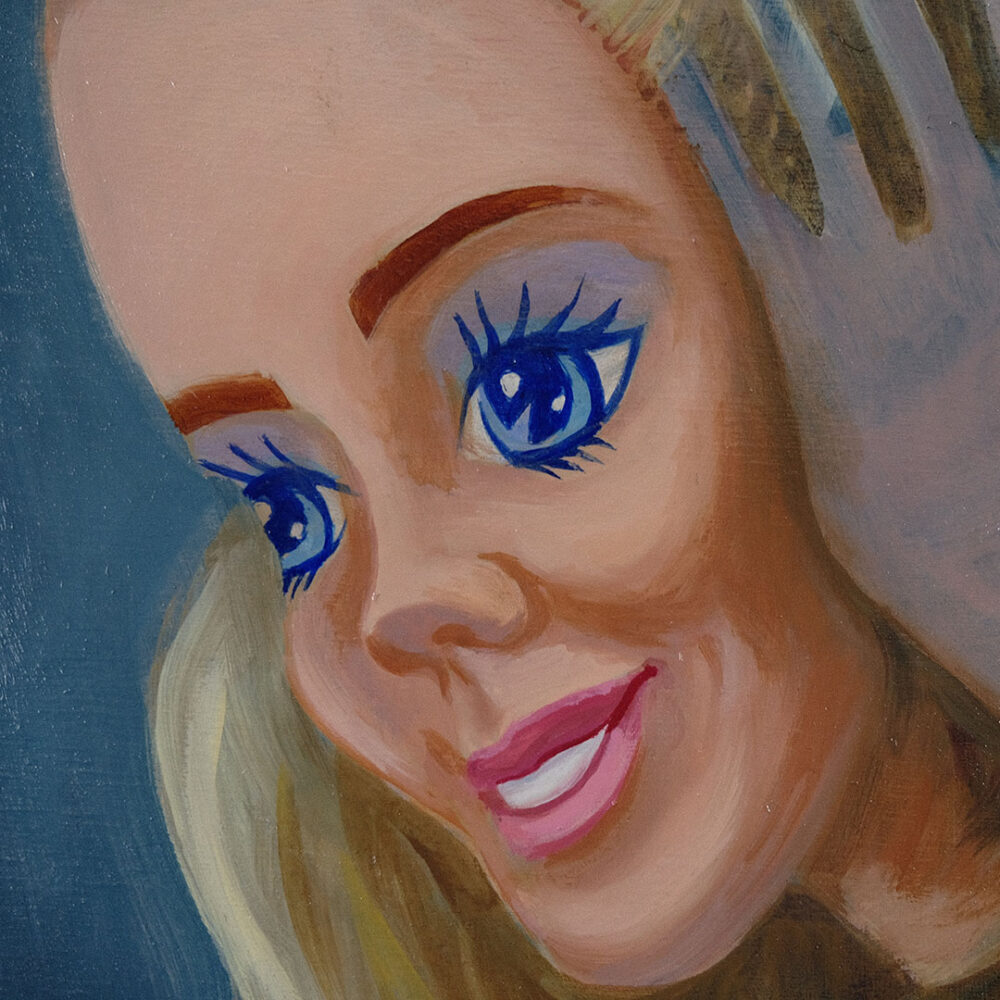
Similarly, in my contemporary paintings, I replace the human figure with symbolic objects to explore themes of childhood memory and motherhood. For example, the first work examines false role models in parenting through the use of a doll’s head. By contrast, the second piece uses a doll’s head to evoke overwhelming feelings from childhood.

More specifically, in my 2017 work False Role Model, I explore the tension I experienced in motherhood. Here, Barbie becomes a representation of the “super mom.” At the same time, as we learn more about child-rearing, the question “What kind of parenting do you practice?” has become common and often judgmental.

Furthermore, with the rise of social media, the pressure on mothers has intensified. Pinterest boards and carefully curated feeds reinforce unrealistic expectations. Everywhere, we see busy moms running six-figure businesses, dressed impeccably, preparing healthy meals, and maintaining immaculate homes. Within this cultural landscape, Barbie represents the false ideal many women feel compelled to emulate.

Ultimately, she becomes an impossible role model — one that breeds unhappiness, frustration, and can lead to depression.

Barbie is Not a Mother” 2017 Oil on wood panel 36″ by 36″ (91.5 cm by 91.5 cm)


It’s an impossible standard to live up to.


In this painting, the table depicts the early stages of meal preparation alongside children’s toys. The never-ending daily tasks — cooking, cleaning, and caregiving — create a constant sense of chaos, both visually and mentally. Through these objects, I represent the basic needs we fulfill as mothers, such as feeding our children, while also suggesting the joys we hope to nurture — a child at play is implied through the scattered toys.

At the same time, among the beets, a human heart appears, symbolizing how much of ourselves we give as mothers. Similarly, the fence represents the tension between the deep instinct to keep our children safe and the caged feeling that can accompany so much responsibility.

Furthermore, the Barbie head — the so-called “perfect mother” — functions as a kind of mask. As it is removed, the figure beneath it appears undefined, almost absent. In this way, the painting marked a monumental shift in my perception of motherhood. When I finally set aside the pressures I felt — the tug-of-war between responsibilities, aspirations, and persistent self-doubt — I realized that my struggle was not simply about time management.The deeper issue was that I no longer knew who I was without the label of “mother.”

I had become missing from my own life.

contemporary artist childhood memory

As a highly sensitive child who immigrated to Canada at the age of three, school was always a struggle. When I think back to my childhood, I realize I don’t remember much. I believe this is because I spent so much time trying not to feel.

As a contemporary female artist, expressing these uncomfortable moments is central to my body of work. In this painting, I chose my childhood doll to represent that desire to hide. I used the head to symbolize the façade a child creates and rendered it clearly. The body, representing feelings that are too difficult to face, is abstract and only suggested. It suggests a disconnect between the head and the body.

In the background, a playground is faintly hinted at, forming a murky and indistinct landscape.

Playground Memories“, 2017 Oil on stretched canvas

16″ by 16″